The Tuesday Ritual

|
Getting your Trinity Audio player ready...
|
On the social physics of mid-week momentum at The Consulate.
The ice in a glass at The Consulate has a specific, high-frequency chime when it’s first dropped into a tumbler, a sound that exists only in the twenty minutes before the room understands it is no longer empty.
It is a sharp, clean sound, unburdened by the ambient roar of the city outside or the low hum of intent that will soon settle over the velvet and wood.
In these early moments of Spartan Tuesdays, the room is merely a vessel—a collection of expertly angled chairs and soft lighting waiting for the first lean of a shoulder or the first tentative pull of a stool.
There is a particular kind of choreography to how a Spartan Café gathering begins.
It does not start with a rush or a grand announcement. Instead, it begins with the arrival of those who understand that in New York, the most important things often happen while everyone else is still deciding whether or not to show up.
The Geometry of Arrival
The first few members arrive with a lack of urgency that borders on the studied. They do not scan the room for targets; they scan for comfort.
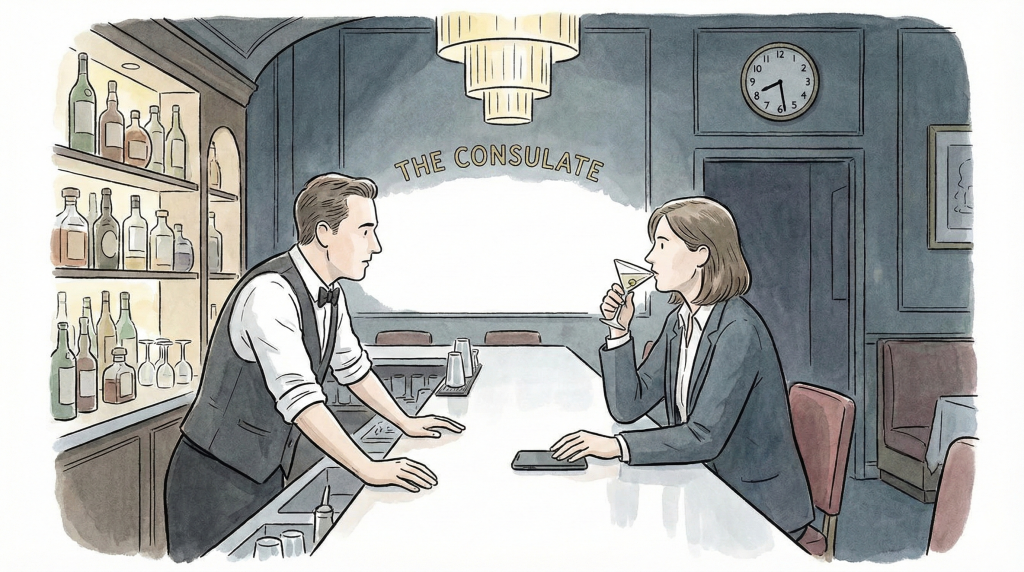
One might choose a corner seat with a view of the door, not out of suspicion, but out of a desire to watch the ecosystem assemble itself. Another stands at the bar, offering a nod to the bartender that suggests a history longer than a single evening.
There is a subtle etiquette to the seating.
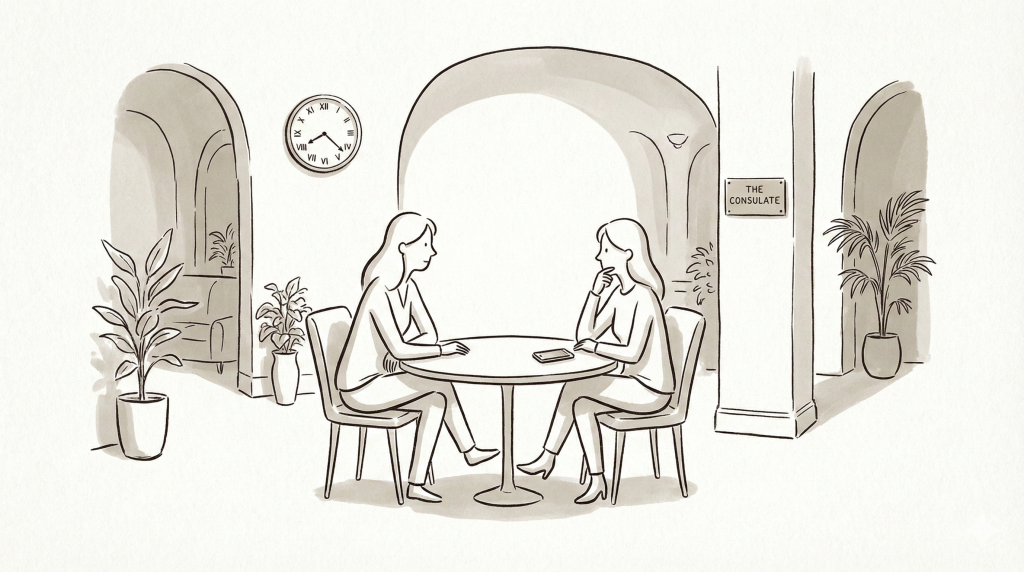
People do not sit directly next to one another initially. They leave a single chair of “social negative space,” an unspoken buffer that allows for the room to breathe.
This isn’t coldness; it is a form of respect for the quiet before the conversation.
As the clock edges past the hour, these gaps begin to close. A hand is placed on the back of a chair—a silent inquiry—and the buffer vanishes. The room tightens. The social physics change from static to kinetic.
The Mid-Week Pivot
A Tuesday in Midtown is a peculiar time. It’s early in the week to early to feel the frantic release of a Friday. This gives the Spartan Café member its primary subject matter: the deliberate use of time.
For the entrepreneur or the operator, Tuesday is the pivot point. It is when the plans made on Monday are tested against the reality of the market.
At The Consulate, this manifests as a shift in posture. You see it in the way a phone is placed face-down on the table—a gesture of total presence that is becoming the highest form of currency in a distracted age.
The conversations here aren’t about “what” someone does; that is assumed to be handled. They are about the “how” and the “why.” They are about the friction of moving a large idea through a small opening.
The lighting helps.
It is warm enough to soften the edges of a hard day’s work but bright enough to read the subtle shift in an expression when a deal is mentioned without being named.
Status is not declared through the loud reading of a résumé; it is implied by the ease with which one occupies their space. The most powerful person in the room is often the one listening with the most stillness.
The Unwritten Social Index
As the evening matures, the room begins to operate as a single organism. The noise level rises to a steady, comfortable thrum—the sound of high-level coordination.
There is a specific way people here introduce others. It is rarely a formal recitation of titles. It is more likely a contextual bridge: “You both seem to be thinking about the same problem from opposite sides of the street.”
It is a reminder that Spartan Café is an ecosystem, not a series of endpoints.
The value of the room isn’t in the business card exchanged (though that happens), but in the recalibration of one’s own perspective.
You leave the room differently than you entered it.
The weight of your own ambitions feels slightly more manageable when you see them reflected in the quiet confidence of thirty other people.
By the time the last few drinks are being finished, the urgency of the outside world has begun to seep back in, but it feels distant.
The city outside is loud and hurried, but inside The Consulate, the pace remains measured. People leave in small clusters, their departures as understated as their arrivals.
There is no “closing ceremony,” no final speech.
There is only the soft click of the door and the realization that the momentum generated in these few hours will likely carry through the rest of the week. The ice has stopped chiming; the tumblers are empty; the room returns to its quiet state. But the air still feels occupied.