
The Architecture of Endurance: Why Discipline Eclipses Motivation in the Pursuit of Legacy

|
Getting your Trinity Audio player ready...
|
Motivation is a fleeting emotion that betrays you when the work gets hard; discipline is the quiet, reliable system that guarantees arrival.
- Discipline vs. motivation
- Long-term business success
- Entrepreneurial mindset
- Overcoming procrastination
- The Spartan mindset
The Great Deception of the “Spark”
If you walk into any gym on January 2nd, the air is thick with electricity. The treadmills are full, the weights are clanging, and there is a palpable sense of collective resolve. This is motivation in its purest form. It is a biological high, a dopamine response to the idea of a better future. It feels good. It feels like progress.
But return to that same gym on February 15th. Statistics show that the crowd has thinned. The electricity is gone. The only people remaining are not the ones who felt the most excitement six weeks prior; they are the ones who have built a system that operates independently of their feelings.
In business and in life, we are often sold a lie: that to produce great work, we must feel inspired. We scroll through social media, looking for that jolt of energy from a guru or a quote card, hoping it will propel us through the day. We treat motivation as if it were a necessary fuel source.
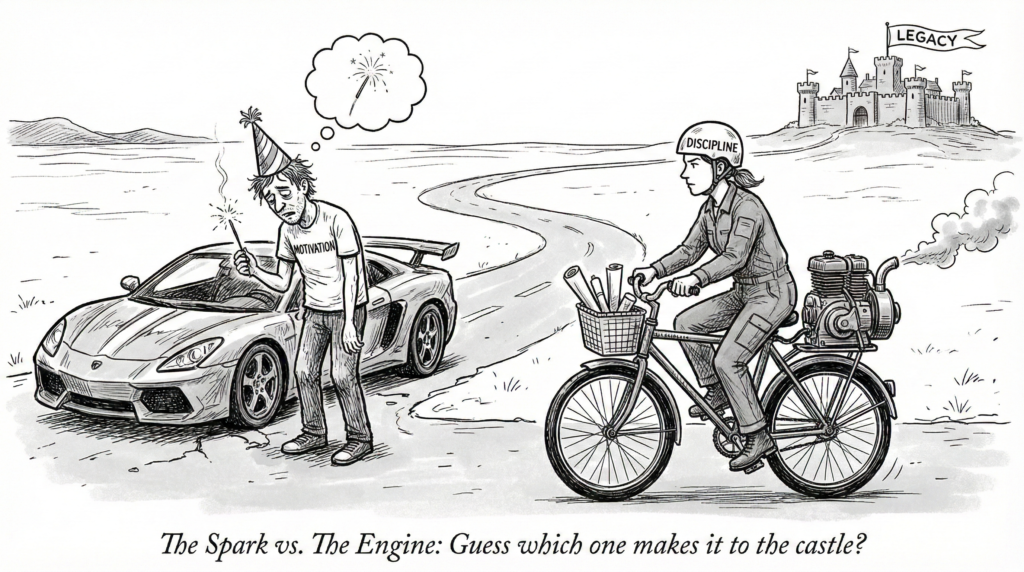
The hard truth, which I have observed over thirty years of consulting and navigating the peaks and valleys of entrepreneurship, is that motivation is not fuel. It is merely the spark. A spark can start a fire, but it cannot sustain one. At Spartan Cafe, we teach that if you rely on the spark to keep your engine running, you will inevitably find yourself stranded on the side of the road the moment the weather turns.
Discipline, conversely, is the engine itself. It is the boring, mechanical, reliable process of doing what needs to be done, regardless of the emotional climate.
The Physiology of the “Quit”
To understand why motivation fails, we have to look at what it actually is. Motivation is largely emotional. It is a state of arousal, usually triggered by a vision of a reward. When you imagine selling your company for millions, or standing on a stage receiving an award, your brain floods with feel-good chemicals. You are motivated.
However, the moment you sit down to do the actual work—the tedious coding, the cold calls, the drafting of legal documents, the restructuring of a failed marketing campaign—the reward feels distant. The dopamine wears off. The “pain” of the work sets in.
If your strategy is built on motivation, this is the moment you quit. You interpret the lack of excitement as a sign that something is wrong. You might think, Maybe this isn’t my passion, or Maybe I’m on the wrong path.
This is the illusion of the “overnight success” culture we live in. We see the highlight reels of others and assume they are perpetually motivated, riding a wave of constant inspiration. We do not see the years of grinding in the dark. We do not see the mornings they woke up exhausted, filled with doubt, and went to work anyway.
The “quit” happens not because we are incapable, but because we have tied our actions to our emotions. The disciplined individual separates the two. They understand that their feelings are valid, but they are not votes. You can feel uninspired and still execute a strategy. You can feel fearful and still make the call.
The “Strenuous Life” and the Vertical Mindset
Theodore Roosevelt spoke famously of “The Strenuous Life”—the idea that the highest form of success comes not from ignoble ease, but from the willingness to embrace difficulty. This philosophy is central to the Spartan ethos. It is the understanding that friction is not an obstacle to the path; friction is the path.
In martial arts, there is a concept of “drilling.” You practice a single movement thousands of times. It is repetitive. It is often boring. There is no applause for the ten-thousandth repetition of a basic block. But in the heat of a match, when adrenaline spikes and chaos ensues, you do not rise to the level of your motivation; you fall to the level of your training.
This is what I call the Vertical Mindset.
- A Horizontal Mindset looks for the next shiny object, the next quick fix, the next burst of motivation. It moves sideways, skimming the surface of many things but mastering none.
- A Vertical Mindset digs deep. It builds a foundation of habits that can support the weight of a skyscraper. It accepts that the digging phase is unattractive and laborious.
When you are operating with a Vertical Mindset, you stop asking, “Do I feel like doing this?” and start asking, “Does this action align with the architecture I am building?”
Discipline as an Act of Self-Respect
There is a misconception that discipline is a form of punishment—that it is rigid, cold, and joyless. In reality, discipline is the highest form of self-love.
When you rely on motivation, you are essentially telling yourself that your long-term goals are less important than your short-term comfort. You are prioritizing the immediate desire to procrastinate over the future version of yourself who wants to succeed.
Discipline is a contract you sign with your future self. It is the decision to forego the immediate pleasure of “taking it easy” to secure the long-term freedom of achievement.
Consider the financial architecture of a business. You might not feel “motivated” to review your cash flow statements or audit your expenses. It is dry work. But the discipline to do so is what prevents bankruptcy. It is what allows you to survive a recession. The disciplined entrepreneur is not lucky; they are prepared. They have built a vessel that can weather the storm because they tightened the bolts on the days when the sun was shining.
The Structure of Consistency: Systems Over Willpower
If we accept that motivation is unreliable, how do we build discipline? We cannot simply “will” ourselves to be more disciplined. Willpower, like motivation, is a finite resource. It creates decision fatigue.
The solution lies in systems. High performers at organizations like Spartan Cafe do not have infinite willpower. They have better systems that reduce the need for willpower.
1. The Power of Time-Blocking
The most common thief of success is “reactive” work. We wake up and immediately respond to emails, texts, and other people’s emergencies. Discipline requires proactively blocking time. If you decide that 8:00 AM to 10:00 AM is for deep, strategic work, you do not wait to see how you feel. You simply execute.
2. The Micro-Win Strategy
Motivation often evaporates because the goal seems too big. “Build a million-dollar company” is a mountain. “Call three prospects” is a step. Discipline focuses on the step. When you break a massive objective down into small milestones, you create your own kinetic energy.
3. Accountability and Environment
The “Lone Wolf” myth is dangerous. If you surround yourself with people who are drifting, you will drift. If you surround yourself with people who are rowing, you will row. This is why environment matters more than intention. At Spartan Cafe, we provide that community of “rowers” who pull you forward when your own engine stutters.
Embracing the “Boring” Middle
Every significant endeavor has three phases:
- The Start: High motivation, high excitement, low competence.
- The Middle: Low motivation, high difficulty, increasing competence.
- The End: High satisfaction, mastery, completion.
The “Middle” is where dreams go to die. This is what Seth Godin calls “The Dip”—the long slog between starting and mastery. Motivation cannot survive the Middle; it requires immediate validation. Discipline, however, understands the concept of “lag time.” It knows that the work you do today may not pay off for ninety days.
This is where the concept of “Ageless Vitality” comes into play—not just in health, but in business. It is the commitment to consistency over intensity. The Middle is the filter. It separates the tourists from the professionals.
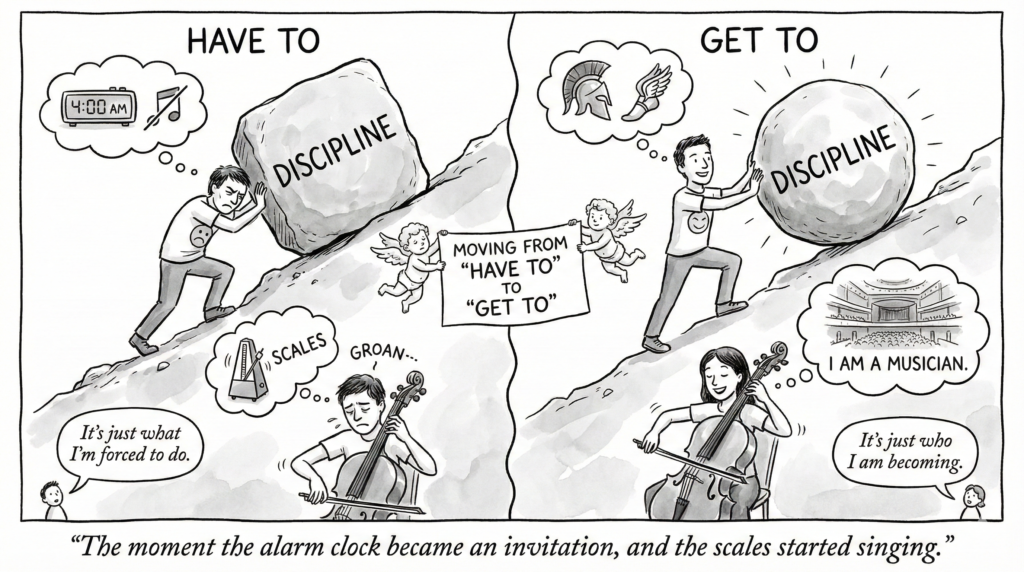
Moving From “Have To” to “Get To”
Ultimately, discipline requires a shift in identity-based habits. You stop viewing the work as something you are forced to do, and start viewing it as something you are privileged to do because of who you are becoming.
When you identify as a “Spartan”—a builder, a doer, a person of resilience—discipline stops feeling like a chore and starts feeling like an expression of your character. You do the hard things because that is simply what people like you do.
FAQ
Q: Can I never use motivation? Is it useless? A: Motivation is not useless; it is just insufficient. Treat it like a bonus. Use it to set the vision, but use discipline to map the journey.
Q: I’m burnt out. Is that a lack of discipline? A: Not necessarily. Rest is a discipline, too. The disciplined leader schedules recovery just as rigorously as they schedule work.
Q: How do I start being disciplined if I’ve always been lazy? A: Start small. Keep one small promise to yourself. Confidence comes from keeping those promises.
Q: What if I miss a day? A: One missed day doesn’t bankrupt you. The Spartan mentality is resilient. Just don’t miss twice.
Q: Doesn’t discipline kill creativity? A: On the contrary, discipline protects creativity. By systematizing the mundane, you free up mental bandwidth for exploration.
Final Thoughts
We live in a world that worships the start. We celebrate the launch parties and the announcement posts. But the world is built by the finishers.
It is taking you so long to succeed not because you lack passion, but perhaps because you have relied too heavily on the emotional high of the start. You have been waiting for the wind to blow before you hoist the sails. The reality is that the wind may never come. You have to grab the oars. That is discipline.
A Call to the Builders
If you are tired of the hype and the sugar-rush motivation, you are looking for a room where the conversation is about the timeless principles of building.
Spartan Cafe was designed for this exact purpose. It is a hybrid ecosystem—a “pocket boardroom”—for those who understand that traction matters more than validation. We provide the tools, the capital access, and the community to help you turn discipline into empire.
We don’t promise it will be easy. We promise it will be worth it.
Join the movement at Spartan Café. Let’s build something that lasts.



Great article!!!