
The Geometry of Presence

|
Getting your Trinity Audio player ready...
|
On John Marcelin and the art of being heard without speaking.
The Mid-Week Threshold
Midtown on a Tuesday exists in a state of suspended animation. The frantic kinetic energy of the morning has curdled into a heavy, post-work resolve.
On West 44th Street, the light catches the condensation on the windows of Kellari Taverna, where the transition from the pavement to the interior is less a walk and more a change in atmospheric pressure.
Inside, the room is a study in Mediterranean white and deep wood, smelling faintly of charcoal-grilled octopus and the sharp, clean scent of chilled Assyrtiko.
This is the ecosystem of Spartan Tuesday, a recurring ritual where the architecture of the room dictates the choreography of the evening. People don’t just arrive here; they settle into layers.
At the center of this social physics is John Marcelin.
He does not announce his arrival with the standard flourishes of the ambitious—there is no loud greeting, no performative checking of a watch, no scanning of the room for someone more important to talk to.
Instead, he simply occupies space. He appears at the edge of a conversation like a thought that has finally found its words.
The Physics of the Circle
Observing Marcelin is an exercise in watching what happens to a room rather than what he does within it.
He has a way of standing—weight slightly back, hands often finding the pockets of a jacket that fits with the quiet precision of something made for him, and only him—that suggests he is perpetually in the middle of a realization.
When he joins a small group near the bar, the geometry changes. A circle that was once jagged and loud begins to smooth out.
People stop trying to talk over one another. A younger man, gripped by the visible tension of wanting to impress, finds himself slowing his speech. Marcelin hasn’t said a word yet; he has only offered a steady, receptive silence.
It is a rare currency in a city that treats conversation as a competitive sport.
Marcelin listens with his entire frame. He doesn’t nod reflexively. When he does speak, it is often a question that feels like it’s been pulled from the very back of the drawer—something simple that reframes the last five minutes of talk.
“The light in here,” he says, gesturing vaguely toward the high, vaulted ceiling where the warm glow of the lamps hits the Greek jars, “it makes everyone look like they’re in a play they didn’t rehearse for.”
The group laughs, but it’s the laugh of people who have just been given permission to stop acting.

Overheard at the Periphery
At Spartan Café, membership is less about a card and more about a shared frequency. This is evident in how Marcelin is discussed when he is ten feet away.
Near the back of the room, by the display of fresh fish bedded in ice, two women in dark silk were nursing drinks. Their conversation was a low murmur until Marcelin’s name surfaced.
“I saw John earlier,” the taller one said, her voice dropping into that specific register used for people who don’t need an introduction. “He has that way of looking at a problem until it just gets tired of being a problem and goes away.
I remember last winter, when the momentum on that Midtown project stalled—everyone was shouting. John just sat there and asked if anyone had actually looked at the foundation. He wasn’t talking about the building.”
The other woman nodded, watching Marcelin across the room. “He’s the only person I know who can make a room feel smaller and more expansive at the same time.”
They didn’t mention what he does for a living. They didn’t mention a company name or a title. In the world of the Spartan Café Blog, those things are the scaffolding—necessary for the build, but irrelevant to the view.

The Taverna as Character
Kellari Taverna serves as the perfect foil for this kind of presence. It is a venue that rewards the patient. The service is a silent, blue-and-white blur; the food arrives with a lack of ego. It is a room designed for the long game.
Marcelin seems to mirror this. He moves through the evening with a lack of urgency that borders on the cinematic.
When a waiter passes with a tray of calamari, Marcelin shifts half an inch to create a path, a movement so fluid it seems choreographed. He is aware of the room’s boundaries.
He knows where the shadows are deepest and where the conversation is most likely to turn from pleasantries to something more permanent.
There is a specific kind of confidence required to be the quietest person at a table of entrepreneurs. It’s the confidence of someone who knows that the loudest person in the room is usually the one with the most to lose.
Marcelin, by contrast, behaves as if he has already won, and is now simply interested in how the game is being played.
The Unnamed Pattern
As the night progresses, the “Spartan Index” becomes visible—those unwritten rules of modern ambition. One of those rules is that the most valuable connections are rarely made through a pitch. They are made through shared observation.
Marcelin finds himself in a corner with a veteran of the New York social circuit. They aren’t talking about capital or scale. They are talking about the texture of the salt on the table. But in that exchange, there is a calibration occurring. They are measuring each other’s restraint.
This is the Spartan Café ethos in its purest form: relationships built in rooms, not inboxes. It is the understanding that who you are is best revealed by how you handle a Tuesday night at a Greek restaurant when no one is asking for your resume.
The Slow Fade
The exit is where the character is finally etched into the mind.
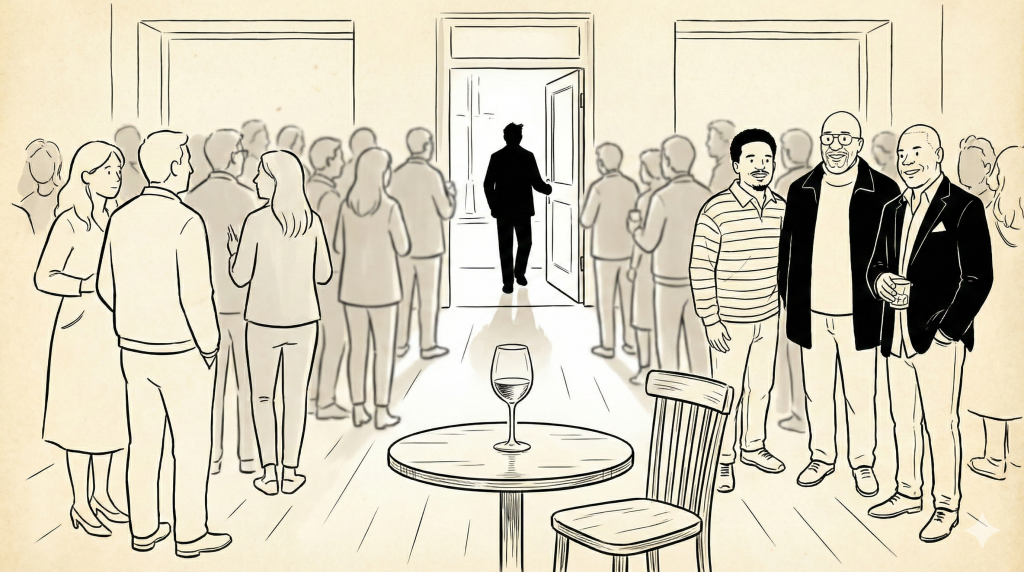
John Marcelin does not do a round of goodbyes. He doesn’t tap a glass. As the clock nears ten, he simply finishes his glass, places it on a coaster with a soft, final click, and begins a slow, deliberate walk toward the door.
He stops once, perhaps to touch the shoulder of a friend or to offer a single, nodding smile to the host. He doesn’t look back. By the time the group he was with realizes he is gone, the space he occupied has already begun to feel slightly colder, slightly less organized.
“Where’d Marcelin go?” someone asks, looking around.
No one saw him leave, but everyone knows he was there. The conversation attempts to resume its previous volume, but the cadence has been permanently altered. He leaves behind a residue of calm—a reminder that in a city of noise, the most powerful thing you can be is a mystery that doesn’t feel the need to be solved.
Out on 44th Street, the air is sharper now. The Midtown lights are still humming, but for those who were in the room, the world feels a little more structured, a little more intentional. That is the Marcelin effect. He doesn’t change the world; he just reminds you that you’re the one who has to live in it.


