
The High Cost of Motion: Why We Mistake Activity for Progress

|
Getting your Trinity Audio player ready...
|
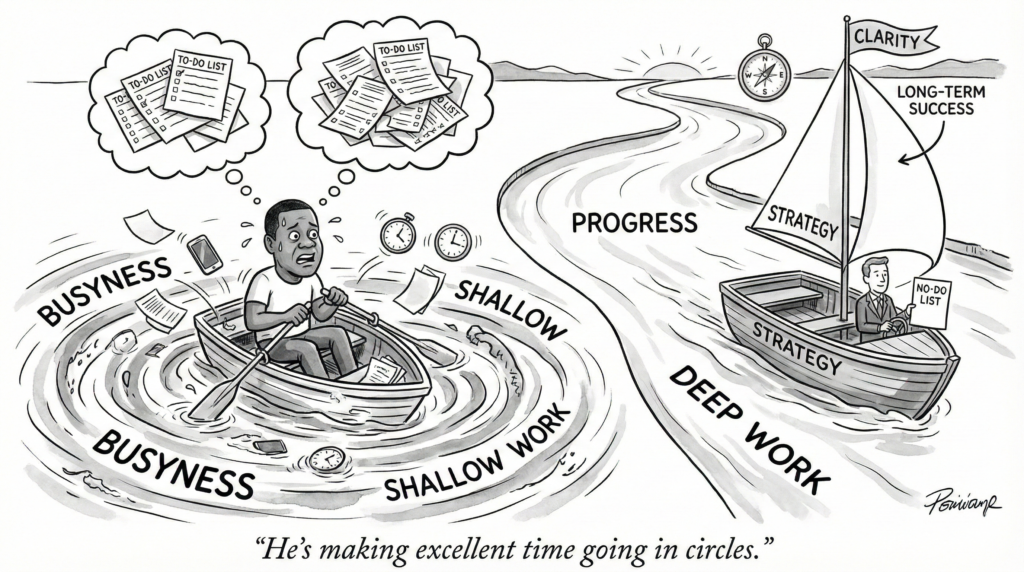
Busyness is often the loudest symptom of a lack of clarity, serving as a comfort for those who fear the stillness required for strategic depth.
- intentional productivity strategies
- busy vs productive mindset
- entrepreneurial focus and clarity
- long-term success frameworks
- eliminating shallow work habits
The Seduction of the To-Do List
We live in a culture that worships the grind. From the moment we wake up, we are bombarded with the idea that the volume of our work is directly proportional to the value of our character.
This is a dangerous lie.
In my thirty years of consulting, I have found that the most “active” people are often the most stagnant.
They have hundreds of unread emails, back-to-back meetings, and a calendar that looks like a game of Tetris. To the outside observer—and often to themselves—they look like the epitome of success. But when you strip away the noise and ask, “How has your business actually moved forward in the last ninety days?” the answer is often a deafening silence.
Busyness is an easy out.
It feels good to check off small, inconsequential tasks. It provides a dopamine hit that masks the reality that we are avoiding the “heavy lifting”—the strategic thinking, the difficult conversations, and the high-stakes decisions that actually move the needle.
The Whirlpool vs. The Current
Think of your career or your business as a vessel on the water. A whirlpool is full of activity; there is speed, there is noise, and there is immense energy being expended. However, the vessel is going nowhere. It is trapped in a circular loop of its own making.
A current, on the other hand, may appear calm on the surface. It might even seem slow. But it possesses a deep, directional power that carries the vessel toward a destination.
Most entrepreneurs are trapped in the whirlpool of “reactive mode.” They spend their days responding to other people’s emergencies, scrolling for “inspiration,” and tweaking minor details of a project that shouldn’t even exist.
Progress is a measure of distance, not speed. If you are moving at one hundred miles per hour in the wrong direction, you aren’t succeeding; you are failing faster.
The Psychology of Shallow Work
Why do we choose activity over progress? Because progress is terrifying.
True progress requires us to step out of our comfort zones and face the possibility of failure. Shallow work—the administrative fluff, the endless “networking” without intent, the obsession with vanity metrics—is safe.
No one ever failed at checking their email.
When we are busy, we have a built-in excuse for why we aren’t where we want to be. “I’m just so swamped,” we tell ourselves. It’s a shield against the internal realization that we lack a clear “Why” or a definitive “How.”
We use busyness to avoid the silence where our doubts live.
Realigning the Compass: Moving from Motion to Momentum
To break this cycle, we must first accept that our time is a finite, non-renewable resource. Every hour spent on a low-impact activity is an hour stolen from our legacy. In my book, 15 Reasons Why It’s Taken You So Long to Succeed, I emphasize that clarity is power. Without it, you are simply a passenger in your own life.
1. The Power of the “No-Do” List
We are taught to add, but success is usually a result of subtraction. The most productive people I know have very short to-do lists but very long “no-do” lists. They have identified the 20% of activities that drive 80% of their results and have ruthlessly eliminated the rest.
If an activity doesn’t directly support your SMART goals—Specific, Measurable, Achievable, Relevant, and Time-bound—it is a distraction. Even if it’s a “good” opportunity, it is a bad decision if it takes you away from your primary objective.
2. Guarding the Deep Work Blocks
In the Spartan Café ecosystem, we often talk about the “Geometry of Presence.” This isn’t just about showing up; it’s about how you occupy your time. I advocate for “Deep Work” blocks—uninterrupted periods of 90 to 120 minutes where the phone is off, the email is closed, and the focus is singular.
You can accomplish more in two hours of deep work than in ten hours of distracted, reactive busyness. This is where the breakthroughs happen. This is where the architecture of success is built.
3. Measuring Impact, Not Effort
We must stop asking “How hard did I work today?” and start asking “What meaningful result did I achieve today?” Effort is an input; impact is an output. The market does not pay for effort. It pays for value.
If you spent eight hours designing a logo that could have been outsourced for fifty dollars, you didn’t “work hard”; you mismanaged your assets. Your job as a leader or an entrepreneur is to leverage your unique strengths for the highest possible return.
The Myth of the Overnight Breakthrough
The illusion of overnight success is a major driver of meaningless activity. People see the “trophy ceremony” and assume it happened in a straight line. In their desperation to catch up, they try to do everything at once. They launch five products, join ten social networks, and start three side hustles.
This “shotgun approach” results in a lot of noise but very little signal. Real success is a slow burn. it is built through the steady accumulation of incremental wins. It is about doing the right thing, consistently, over a long period.
When you stop trying to be everywhere at once, you finally have the bandwidth to be excellent where it actually counts.
The Role of Community in Clarity
Isolation breeds busyness. When you are the only one looking at your business, it is easy to convince yourself that you are making progress. You need a council of peers—a group of “doers” who will look at your activity and ask the hard question: “So what?”
This is why we built Spartan Café. It isn’t just a social network; it’s a corrective environment. It’s a place where we strip away the vanity and focus on the traction. When you are surrounded by people playing the long game, you lose the urge to participate in the shallow sprints of the crowd.
FAQ: Navigating the Activity Trap
Q: How do I know if I’m being busy or productive? A: Look at your primary goal. If you can’t draw a direct line between your current task and that goal, you are likely just being busy. Productivity always leaves a trail of tangible progress; busyness just leaves you tired.
Q: I have to do administrative tasks to keep the lights on. How do I avoid the trap? A: Use the “Batching” method. Dedicate one specific block of time—perhaps on a Friday afternoon—to handle all administrative tasks. Do not let them bleed into your “Prime Time” hours when your mental energy is at its peak.
Q: What if I feel guilty when I’m not “doing something”? A: This is a mindset issue. You must reframe rest and strategic thinking as “active” components of success. A general doesn’t win a war by being the busiest person on the battlefield; they win by having the clearest plan.
Q: Does technology help or hinder this process? A: It depends on the tool. If your “productivity” apps require more time to manage than the tasks themselves, they are time thieves. Use tools that automate the shallow so you can focus on the deep.
Final Thoughts
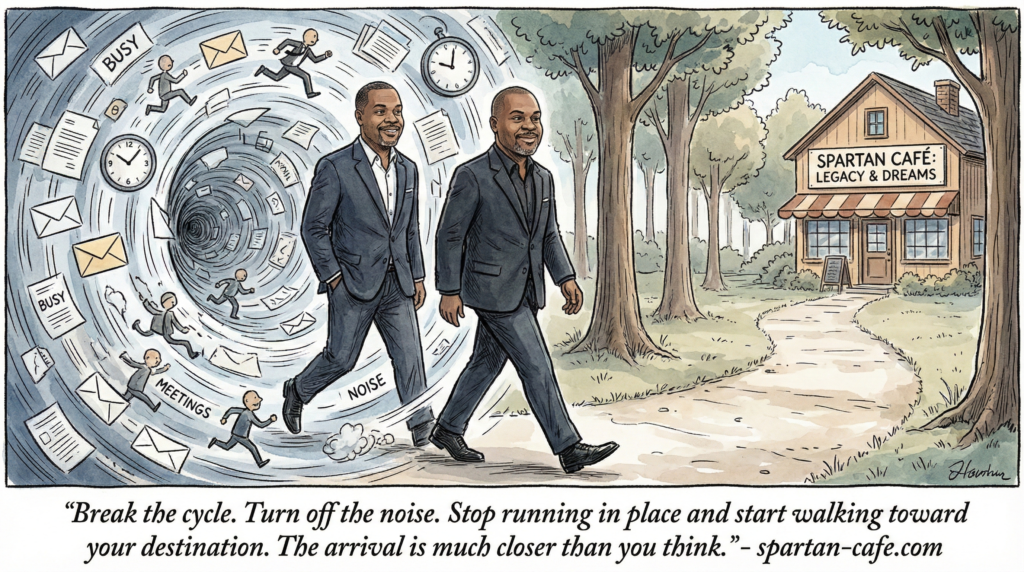
The world will always try to pull you into the whirlpool. There is a strange social comfort in being “too busy.” It makes us feel important, needed, and occupied. But at the end of your journey, you won’t care about how many emails you answered or how many meetings you attended. You will care about the legacy you built and the dreams you realized.
Break the cycle. Turn off the noise. Stop running in place and start walking toward your destination. It might feel slower at first, but I promise you, the arrival is much closer than you think.
If this way of thinking resonates, there’s more where this came from. We invite you to step out of the digital noise and join us at Spartan Café—an intellectual home for those committed to the long game of success. Join the movement at spartan-cafe.com.


